
HVAC training eligibility: what providers usually require
What partner HVAC training providers in Charlotte usually ask for: age, education, background and the documents to have ready. Requirements vary by provider.
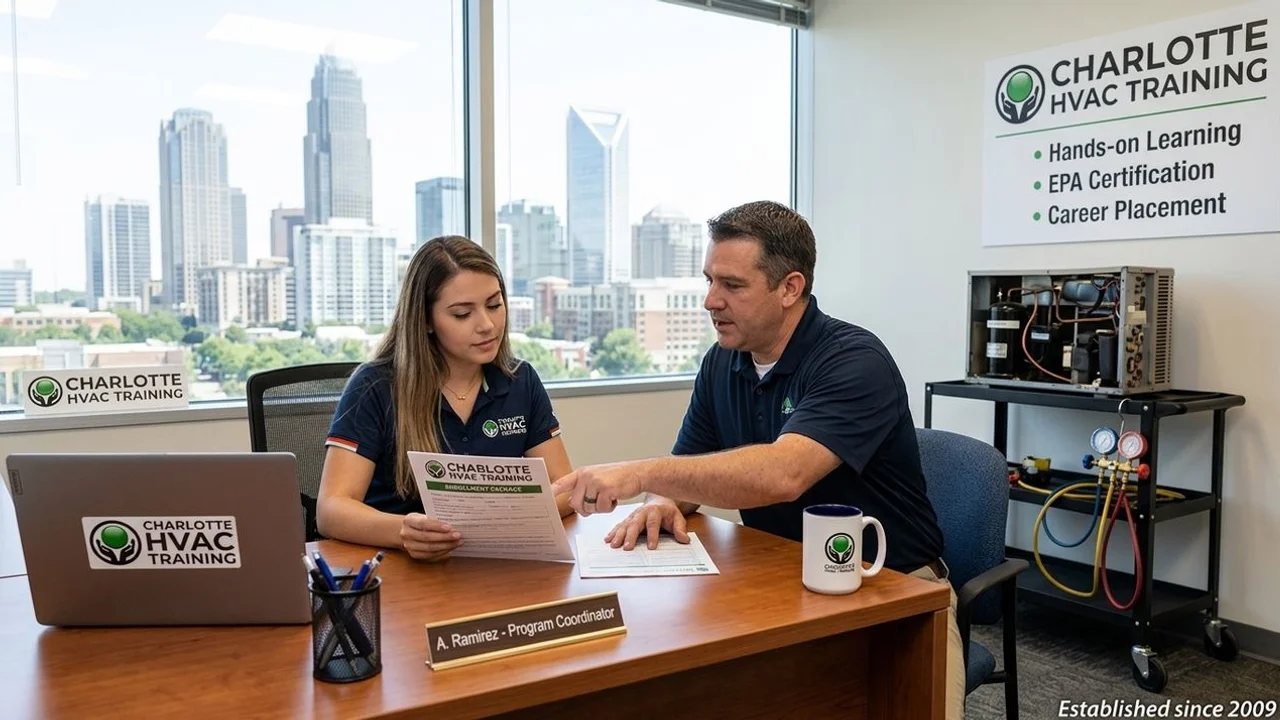
Finding reliable technicians is a common struggle for local property managers, and it is one reason more Charlotte residents are looking at HVAC as a career. Before you apply anywhere, it helps to know what HVAC training providers usually ask for.
GiveNGo does not run HVAC training or decide who is accepted. We connect people with partner training providers. Every provider sets its own requirements, so use this page as a checklist of what to expect and then get matched with a provider.
Many partner programs follow the PACT eligibility framework, a USDOL-recognized pre-apprenticeship model delivered by partner providers. HVAC programs often add a few physical and technical expectations on top of that.
The Bureau of Labor Statistics projects steady job growth for HVAC mechanics and installers over the next decade.
What providers typically require
Requirements differ from one provider to the next. Some programs welcome youth and adults without a high school diploma. Others ask for a diploma or GED. Ask each provider directly before you plan around any one rule.
- Age. Some programs serve youth 14 to 17 and others serve adults 18 and older.
- Residency. Many programs prefer applicants who live in Charlotte-Mecklenburg or nearby areas.
- Education. Some providers do not require a high school diploma. Others do. Ask about GED options if you need one.
- Justice involvement. Policies vary. Many providers review records case by case, and some work with North Carolina second chance initiatives.
What HVAC adds on top
HVAC work involves physical labor, diagnostic tools and refrigerant rules. Quality programs set expectations in these areas early.
- Physical demand. The job involves climbing ladders, crawling through attics and lifting heavy equipment such as heat pumps. Be ready for physical work or ready to build up to it.
- Tool comfort. Programs usually introduce digital multimeters and pressure gauges. Prior experience is often not required.
- EPA 608 certification. Quality programs prepare you for the EPA 608 exam, which covers Core safety plus Type I, Type II and Type III appliance categories. Tell the provider early if you have test anxiety so accommodations can be discussed.
What to bring to an intake meeting
Providers commonly ask for a few documents. Having them ready speeds up the process, and most providers let you submit missing items later.
- ID. A valid government-issued photo ID.
- School documents. Transcripts are often optional but can help.
- Probation conditions. Bring these if they apply so schedules can be planned around them.
- Referral paperwork. Include this if a counselor or local agency referred you.
- Prior experience. Proof of earlier trade hours or an OSHA 10 card can help.
How to get matched
The first step is a short conversation with us. Use the contact form and tell us you are interested in HVAC. We will ask about your goals, schedule and situation, then point you to partner providers that may fit. The provider handles its own application and acceptance decisions.
What training costs
Cost varies by provider. Some partner programs are tuition-free for eligible participants, so ask the provider what applies to you. Paid trade school programs often charge tuition plus fees for books and tools. When you compare options, ask about tuition, application fees, tools and exam fees.
A professional starter toolkit can cost several hundred dollars, so ask whether tools are provided during training. Building a personal tool bag slowly once you start working is usually smarter than buying everything at once.
Schedule realities
Many pre-apprenticeship programs follow the 25/75 PACT model, which mixes classroom theory with extensive hands-on hours. Ask each provider how its hours are split, when classes meet and whether schedules can work around school or a job.
What if I am not sure HVAC is right for me?
That is normal. Modern home systems are integrated, so skills often overlap with electrical and plumbing work. Tell us about your interests and income goals when you contact us, and we can talk through HVAC and other construction trades. See also what an HVAC technician does.
How GiveNGo helps
GiveNGo does not run HVAC training. We connect people with partner training providers in Charlotte-Mecklenburg.
- Tell us what you are looking for. Share your goals, your schedule and any questions about eligibility or funding.
- We match you with a partner provider. We look for a provider that fits your schedule, eligibility and funding situation.
- You move forward with support. We help you take the next step with the provider you choose.
Get matched with a provider. Availability, eligibility and funding vary by provider. GiveNGo cannot guarantee acceptance, funding or placement.
Common Questions
Do I need a high school diploma for HVAC training?
Can I join HVAC training if I am on probation?
How much does HVAC training cost?
Does GiveNGo teach HVAC?
Ready to explore HVAC training?
Tell us what you are looking for and we will match you with a partner training provider that fits your schedule, eligibility and funding.