
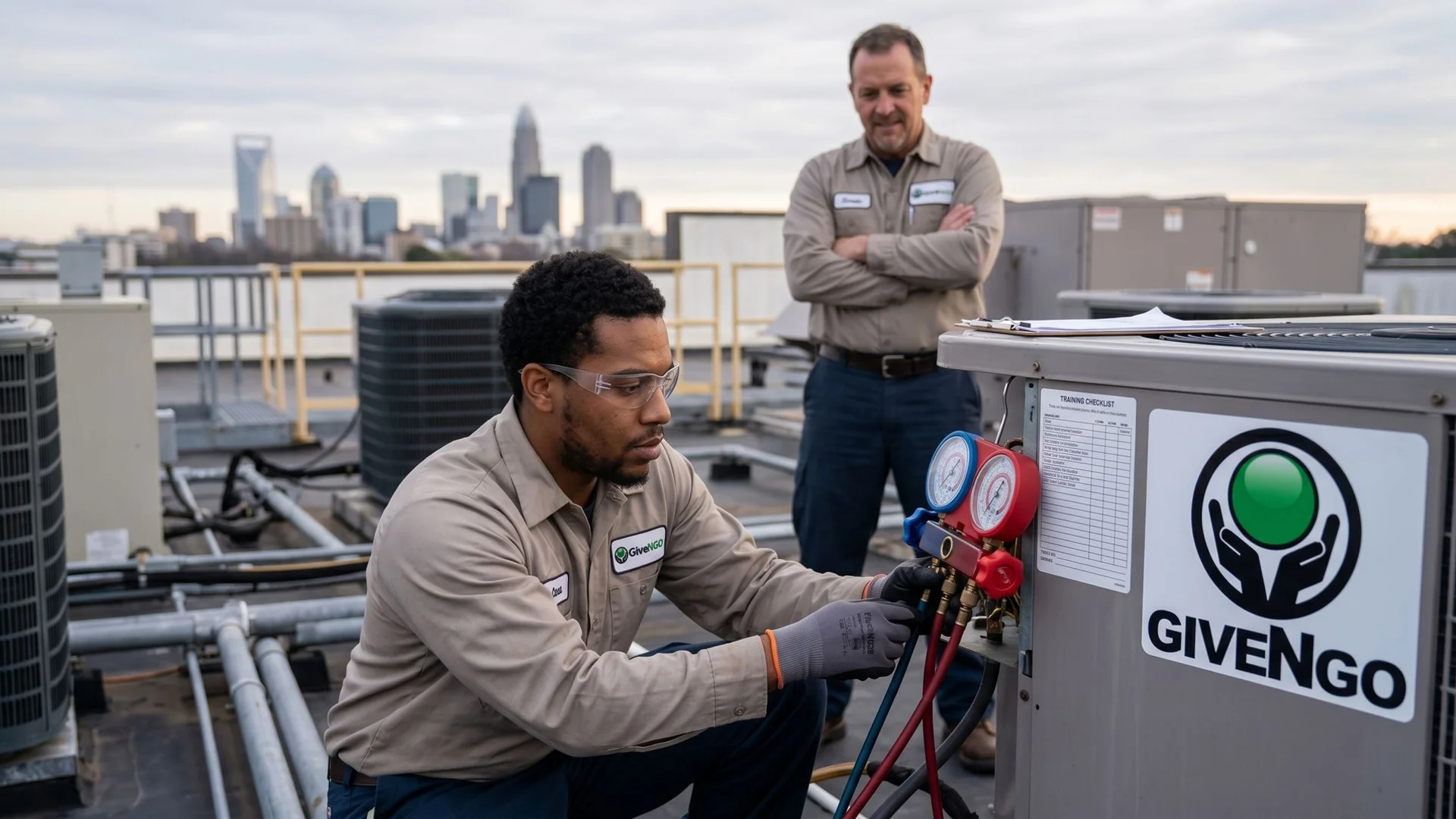
Find HVAC Training in Charlotte
We connect you with partner HVAC training providers in Charlotte-Mecklenburg.
Charlotte’s residential and commercial HVAC market is short on qualified technicians. GiveNGo does not teach HVAC. We connect you with partner training providers, then help you compare options on schedule, eligibility and funding. This page explains what quality HVAC training typically covers, including refrigeration basics, OSHA 10 safety and EPA 608 certification, so you know what to look for.
Finding HVAC Training in Charlotte
Charlotte’s residential and commercial HVAC market is hiring faster than it can train. An aging workforce, new multifamily construction and a regional data center boom all push demand for qualified technicians well past available supply.
If you want a real path into HVAC work in Charlotte, the first step is finding the right training provider. GiveNGo connects you with partner providers so you do not have to sort through the options alone.
What to look for in an HVAC training program
Quality HVAC programs cover four core areas that every entry-level technician needs before landing a paid role. These skills form the foundation of safe, accurate service work.
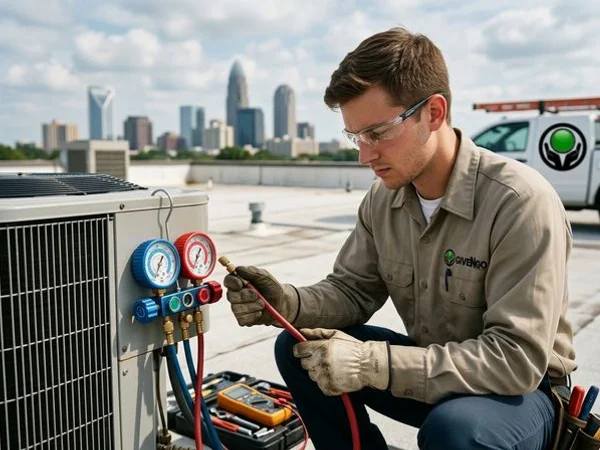
- Refrigeration cycle. Look for a program that explains how heat moves, why pressure-temperature relationships matter and how to read a manifold gauge set.
- Controls and tools. Good programs include time with industry-standard gear like multimeters for safe electrical diagnostics, along with the hand tools used every day.
- Safety and PPE. Look for OSHA 10 construction safety, strict refrigerant handling rules, lockout and tagout procedures and ladder safety.
- Load calculation basics. A working introduction to Manual J and Manual D helps a new technician read what a designer specified and verify system sizing on the job.
EPA 608 certification
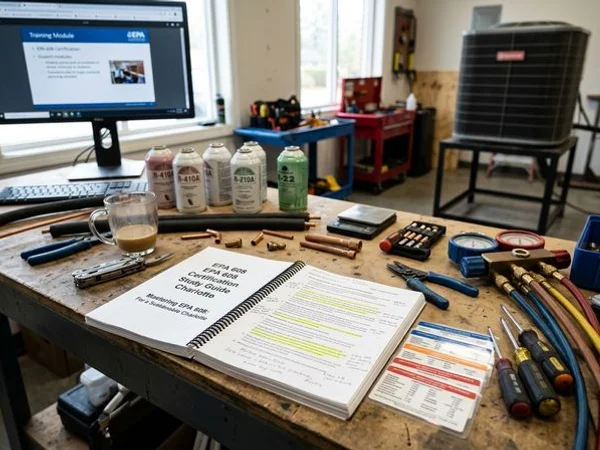
If you handle refrigerant, you need EPA 608 certification. This federal requirement is strict, and the credential lasts for life.
A strong program prepares you for all four sub-types so you can legally work on any system. The test is difficult and demands serious study.
- Core section. This mandatory foundation covers environmental laws and basic safety.
- Type I. This covers small appliances containing under 5 pounds of refrigerant.
- Type II. This section focuses on the high-pressure systems typically found in residential homes.
- Type III. This part involves low-pressure systems used in large industrial applications.
Test takers must correctly answer at least 18 out of 25 questions to hit the 70% passing score for each module. You cannot pass any Type certification if you fail the Core, so ask providers how they prepare students for the environmental regulations, leak rate math and safe recovery protocols.
Hands-on training
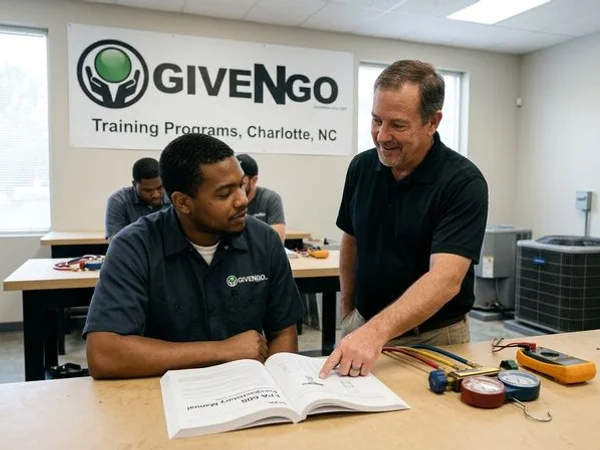
Look for a program that goes beyond simple bench exercises. Charlotte HVAC employers want technicians who already know what a callback ticket looks like and who can clean a micro-channel condenser without bending the fragile fins.
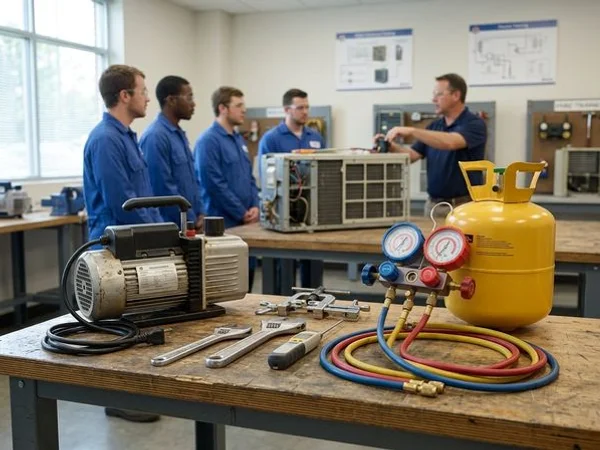
A well-rounded program typically balances three settings:
| Training environment | Primary focus | Practical application |
|---|---|---|
| Classroom | Electrical theory and safety | Preparing for the EPA 608 exam |
| Lab station | Component identification | Reading a manifold gauge set |
| Job site | Real-world diagnostics | Managing customer callback tickets |
Career pathway
HVAC offers stability and growth potential for new technicians. Common entry points include:
- Entry-level residential installation
- Light commercial HVAC service
- Registered Apprenticeship programs
According to a 2026 report citing the North Carolina Department of Commerce, skilled HVAC jobs in the state are projected to grow by 10% through 2030. See the HVAC technician salaries guide for pay ranges in Charlotte.
If you are deciding between a partner program and a paid trade school, our HVAC training vs trade school comparison walks through the practical trade-offs.
How GiveNGo helps
GiveNGo does not run HVAC training. We connect people in Charlotte-Mecklenburg with partner training providers. Here is how it works:
- Tell us what you are looking for. Share your goals, schedule and any eligibility or funding questions.
- We match you with a partner provider. We look for a provider that fits your schedule, eligibility and funding.
- You move forward with support. We stay in touch as you take the next step.
Ready to start? Use the contact form to get matched with a provider.
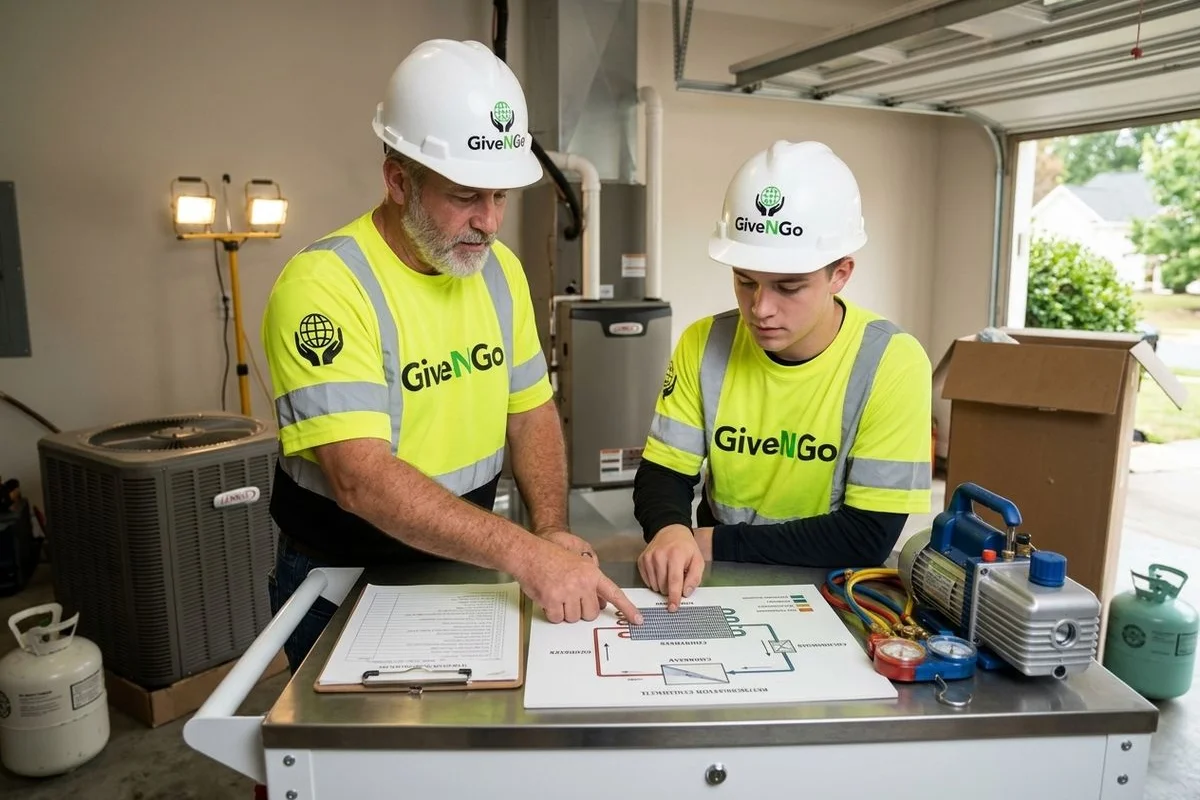
What to look for in an HVAC program
- • Refrigeration cycle, controls and load-calculation basics
- • Hands-on time with manifold gauges, multimeters, hand tools and PPE
- • OSHA 10 safety training
- • EPA 608 certification preparation for all four sub-types
- • Lab or job-site hours with HVAC employers
- • A pathway into Registered Apprenticeships and entry-level technician roles
What an HVAC pathway typically covers
Refrigeration & Tools
Refrigeration cycle, manifold gauges, multimeters, hand tools, PPE.
Safety + Code
OSHA 10 safety, refrigerant handling, regulatory context.
EPA 608 Prep
Universal, Type I, II and III sub-type preparation.
Field Hours
Hands-on lab or job-site time with HVAC employers.
Connecting People and Opportunities
Building partnerships that create real impact in Charlotte-Mecklenburg.
Ready to Get Connected?
We help connect individuals with the right opportunities through our partner network.
HVAC: Common Questions
Find answers about connecting with opportunities and partners.
Does GiveNGo teach HVAC?
How do I get started?
Do I need EPA 608 to start HVAC training?
How much does HVAC training cost?
Can I switch to plumbing or electrical after HVAC?
Explore More Pathways
PACT Pre-Apprenticeship
Learn about the PACT pre-apprenticeship pathway and how GiveNGo connects people with it.
Find electrical trainingElectrical Training
Find entry-level electrical training in Charlotte and learn what quality programs cover.
Find plumbing trainingPlumbing Training
Find plumbing training in Charlotte and learn what quality programs cover.
Ready to get connected?
Whether you're looking for opportunities, seeking to partner, or wanting to support our mission. We'd love to hear from you.