
What does an HVAC technician do day to day?
A plain-English look at the work HVAC technicians do across Charlotte residential and light commercial jobs: install, service, repair and refrigerant handling.
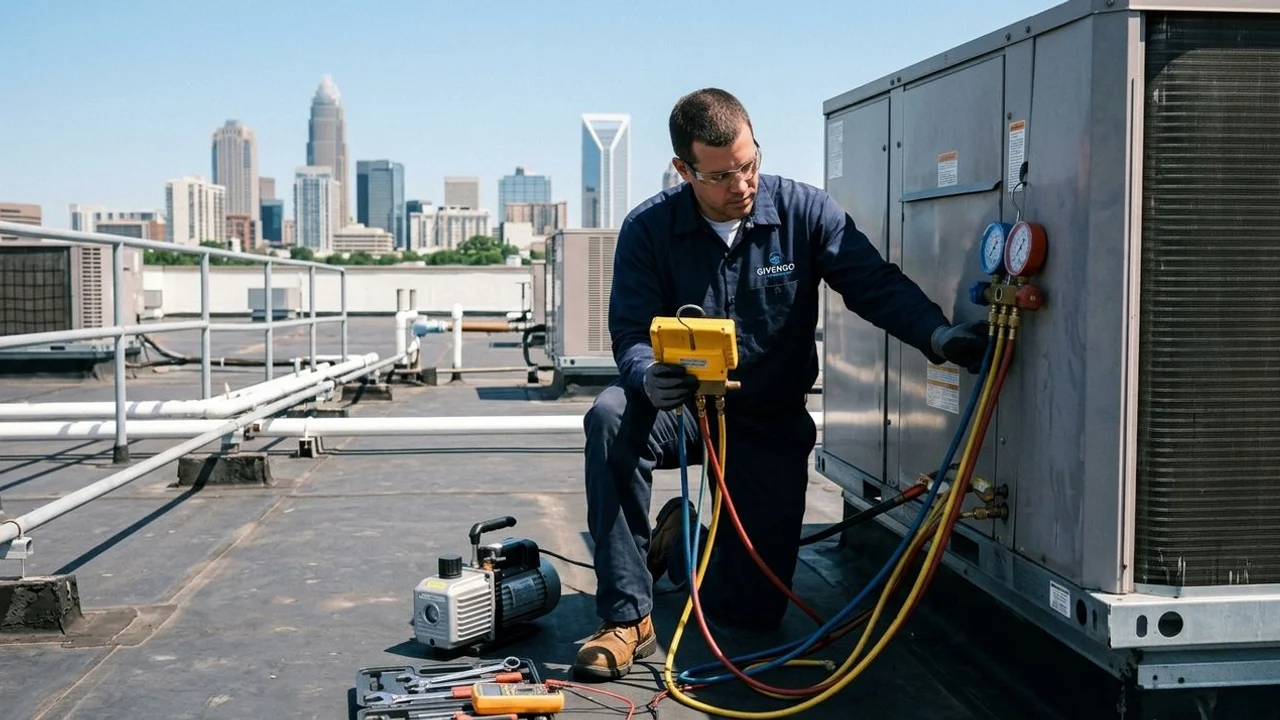
Homeowners and business managers often wonder what happens during a service call. You might see a van pull up and ask what an HVAC technician does behind the scenes to keep the climate control running.
The work goes far beyond swapping air filters. Charlotte has a lot of construction activity, and technicians increasingly handle complex electrical and mechanical systems. This guide covers daily duties, common tools and what the local market tends to hire for.
The day to day
An HVAC technician installs, services and repairs heating, ventilation and air conditioning equipment. The work ranges from electrical diagnostics to residential system tune-ups and requires a solid grasp of mechanical codes and safety rules.
A standard service call often starts with preventive maintenance. Technicians check refrigerant pressures, clean condenser coils and replace worn parts. A typical Charlotte residential service technician handles duties like these:
- Run a maintenance call. Test capacitors and inspect the flame sensor to prevent seasonal breakdowns.
- Diagnose a no-cool call. Use a multimeter to test contactors and control circuits before recovering and recharging refrigerant.
- Install a new system. Mount the air handler, set the condenser pad, run the line set, braze fittings and pull a vacuum.
- Document the job. Give customers photos, performance details and parts lists.
Light commercial work adds another layer. Technicians service packaged rooftop units and large air handlers for retail spaces and offices, often coordinating with facility managers to limit downtime. Expect to spend time crouching in tight spaces or lifting heavy components.
The tools
Technicians rely on a specialized toolkit to diagnose and repair systems safely. Electrical meters, pressure gauges and recovery equipment cover most phases of a job, and proper gear protects the worker from high-voltage hazards.
A digital multimeter is a daily tool for electrical troubleshooting. Federal rules also require certain equipment, such as recovery machines, so refrigerant is captured instead of vented into the atmosphere.
| Tool category | Typical equipment | Main use |
|---|---|---|
| Refrigerant handling | Manifold gauge set, recovery machine | Checking pressures and capturing old refrigerant |
| Electrical diagnostics | True RMS multimeter | Testing voltage, continuity and capacitor microfarads |
| System evacuation | Vacuum pump and micron gauge | Removing air and moisture before charging a system |
| Mechanical work | Copper cutters, flaring kit, brazing torch | Sizing and connecting refrigerant lines |
Technicians who touch refrigerant also need EPA 608 certification, which federal law requires. The Universal level covers all equipment types, and earning it means passing a proctored exam.
What you do not do
You do not spend your days at a desk. The work is mobile, with different neighborhoods and job sites most days. You may climb ladders to reach rooftop units or crawl into attics to inspect ductwork.
Common misconceptions about the job include:
- Predictable environments. Temperatures vary with the season and the failed equipment.
- Repetitive tasks. Each diagnostic call can be a new puzzle.
- Strictly indoor work. Outdoor condensers get serviced in rain, heat and cold.
The Bureau of Labor Statistics reports that the trade has about 40,100 openings each year on average, many from workers leaving or retiring. Check the BLS Occupational Outlook Handbook for the latest figures.
What Charlotte tends to hire for
The local market mixes residential expertise with specialized commercial skills. Steady population growth and commercial investment keep demand strong. A 2026 report from ABC Carolinas noted that data centers along the I-85 corridor are a major driver of commercial construction.
Charlotte's market mix includes these sectors:
- Residential service. Older single-family housing stock plus a growing multifamily build-out.
- Light commercial. Restaurants, retail and office parks that rely on packaged rooftop units.
- New construction. Builders using Manual J and Manual D load and duct design for energy-efficient housing.
- Data centers and healthcare. Precision cooling for high-tech facilities, often suited to advanced technicians.
- Refrigeration. Grocery and food-service work, less common for entry-level workers.
How you get started
Most people start with a structured training program and the EPA 608 certification, then look for an entry role or a Registered Apprenticeship with a mechanical contractor. Training providers vary, so compare programs on cost, schedule, credentials and hands-on hours.
Review HVAC training eligibility to see what providers usually require. Then read the HVAC technician salaries and careers guide to understand how pay tends to grow with experience.
How GiveNGo helps
GiveNGo does not run HVAC training. We connect people with partner training providers in Charlotte-Mecklenburg.
- Tell us what you are looking for. Share your goals, your schedule and any questions about eligibility or funding.
- We match you with a partner provider. We look for a provider that fits your schedule, eligibility and funding situation.
- You move forward with support. We help you take the next step with the provider you choose.
Get matched with a provider. Availability, eligibility and funding vary by provider. GiveNGo cannot guarantee acceptance, funding or placement.
Common Questions
Is HVAC residential or commercial work?
Do HVAC technicians work outside?
Is HVAC work physical?
How do I get started in HVAC?
Ready to explore HVAC training?
Tell us what you are looking for and we will match you with a partner training provider that fits.