
HVAC training: tools, skills and safety to look for
What to look for in an HVAC training program in Charlotte: refrigeration basics, tools, OSHA 10, controls and EPA 608 preparation.
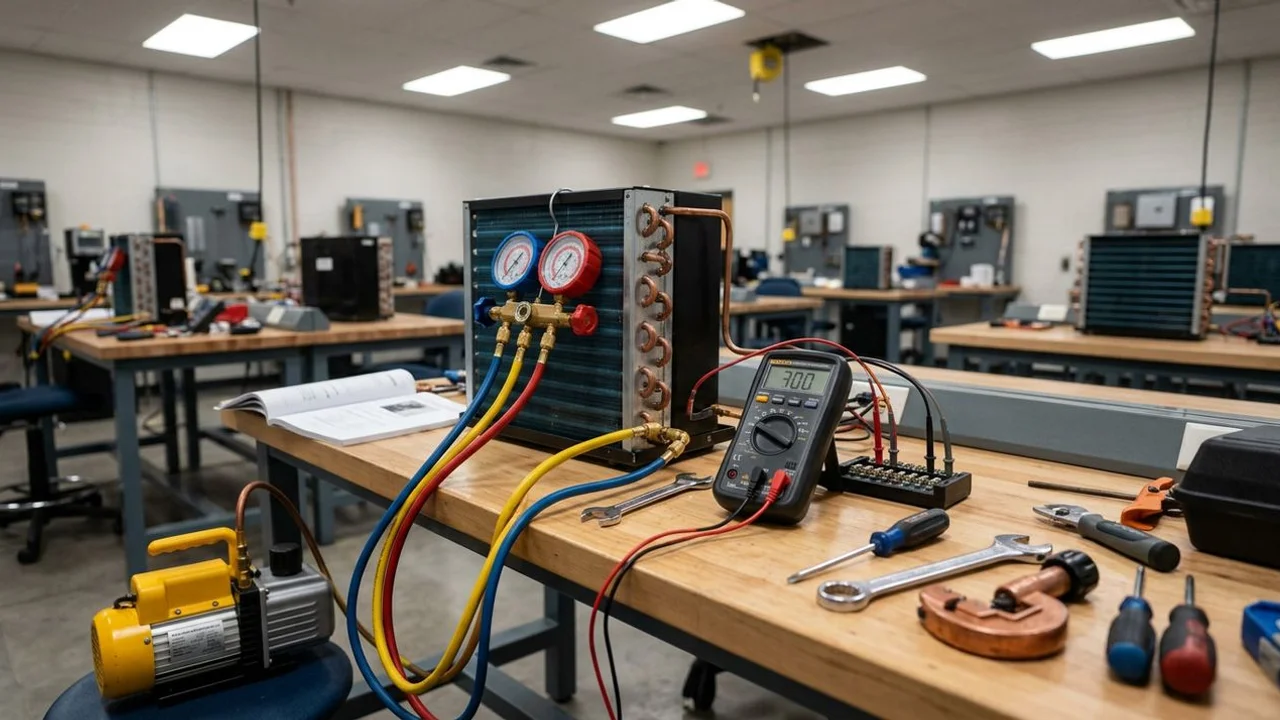
Property managers and homeowners want technicians with proper, modern training. If you are choosing an HVAC training program, it helps to know what a strong one covers.
GiveNGo does not teach HVAC. We connect people with partner training providers. Use this page as a checklist of what a quality HVAC pathway typically covers, then ask providers how they handle each area.
What to look for: the refrigeration cycle
Heat does not disappear from a building. It moves from one place to another, and the refrigeration cycle is how. Quality programs make sure trainees can picture the cycle and explain each stage.
- The compressor pressurizes refrigerant gas.
- The condenser releases heat outside as the gas turns to liquid.
- A metering device drops the pressure suddenly.
- The evaporator absorbs indoor heat as the liquid turns back to gas.
- The gas travels back to the compressor and the loop repeats.
Look for a program that teaches trainees to read pressure-temperature charts accurately. A misreading can lead to equipment damage, and tracing symptoms back to their cause is the key to fast repairs.
What to look for: tools and test equipment
Accurate measurements are the heartbeat of any repair. A good program gives trainees hands-on time with the equipment used on real service calls.
Digital vs analog gauges
Manifold gauge sets are central to HVAC work. Trainees should practice connecting service ports properly, reading the high and low sides and recovering refrigerant safely.
| Feature | Analog gauges | Digital gauges |
|---|---|---|
| Main benefit | Durable and simple | Easier logging and calculations |
| Best use | Basic pressure readings | Detailed system diagnostics |
Essential diagnostic gear
- Multimeters verify voltage, continuity and capacitor microfarads.
- Vacuum pumps and micron gauges pull a deep vacuum before charging.
- Hand tools for cutting, swaging, flaring and brazing are part of installation work.
Personal protective equipment
Eye, hand and hearing protection are expected on the job. Refrigerant-handling safety protects both the worker and the property. Ask providers how they teach and enforce PPE habits.
What to look for: OSHA 10 and site safety
Charlotte construction and service employers like to see an OSHA 10 card on a resume. Quality programs build site safety into the training rather than treating it as an afterthought.
Refrigerant-handling rules align with Section 608 of the Clean Air Act. Important safety topics include:
- Ladder safety and fall protection.
- Hot work and brazing safety to prevent accidental fires.
- Attic and confined-space awareness.
What to look for: controls and diagnostics
Modern HVAC is heavily electronic, so a good program spends real time on controls. Trainees should learn basic electrical theory, including series and parallel circuits, voltage drop and Ohm's law.
Component testing covers capacitors, contactors, transformers and motors. Thermostat wiring, common-wire setups and a repeatable diagnostic flow help technicians avoid guessing at problems.
Capstone: EPA 608 preparation
Federal law requires EPA 608 certification for anyone who handles refrigerant. The Environmental Protection Agency regulates these chemicals to prevent ozone depletion, and violations can bring serious fines.
The exam has four options. Type I covers small appliances, Type II covers high-pressure systems and Type III covers low-pressure chillers. A Universal pass covers all three. Many technicians aim for Universal for maximum flexibility. For the deeper guide, see EPA 608 certification explained.
What a good pathway leaves you with
Ask each provider what you will have in hand when you finish. Common outcomes include:
- Documented lab and job-site hours.
- Readiness for the EPA 608 exam.
- OSHA 10 completion.
- A pre-apprenticeship credential, such as a USDOL-recognized PACT certificate, where the provider offers one.
Outcomes and employer connections vary by provider. No provider can promise a job.
How GiveNGo helps
GiveNGo does not run HVAC training. We connect people with partner training providers in Charlotte-Mecklenburg.
- Tell us what you are looking for. Share your goals, your schedule and any questions about eligibility or funding.
- We match you with a partner provider. We look for a provider that fits your schedule, eligibility and funding situation.
- You move forward with support. We help you take the next step with the provider you choose.
Get matched with a provider. Availability, eligibility and funding vary by provider. GiveNGo cannot guarantee acceptance, funding or placement.
Common Questions
Do I need to bring my own tools to HVAC training?
How much time is classroom vs hands-on?
What gets tested in HVAC training?
Does GiveNGo teach HVAC?
Ready to find HVAC training?
Tell us what you are looking for and we will match you with a partner training provider that fits your schedule, eligibility and funding.