
What PACT training covers: the 25/75 model
How PACT pre-apprenticeship pathways are structured: 25% classroom and 75% work-based hours. What a quality program typically covers and how GiveNGo helps you find a partner provider.
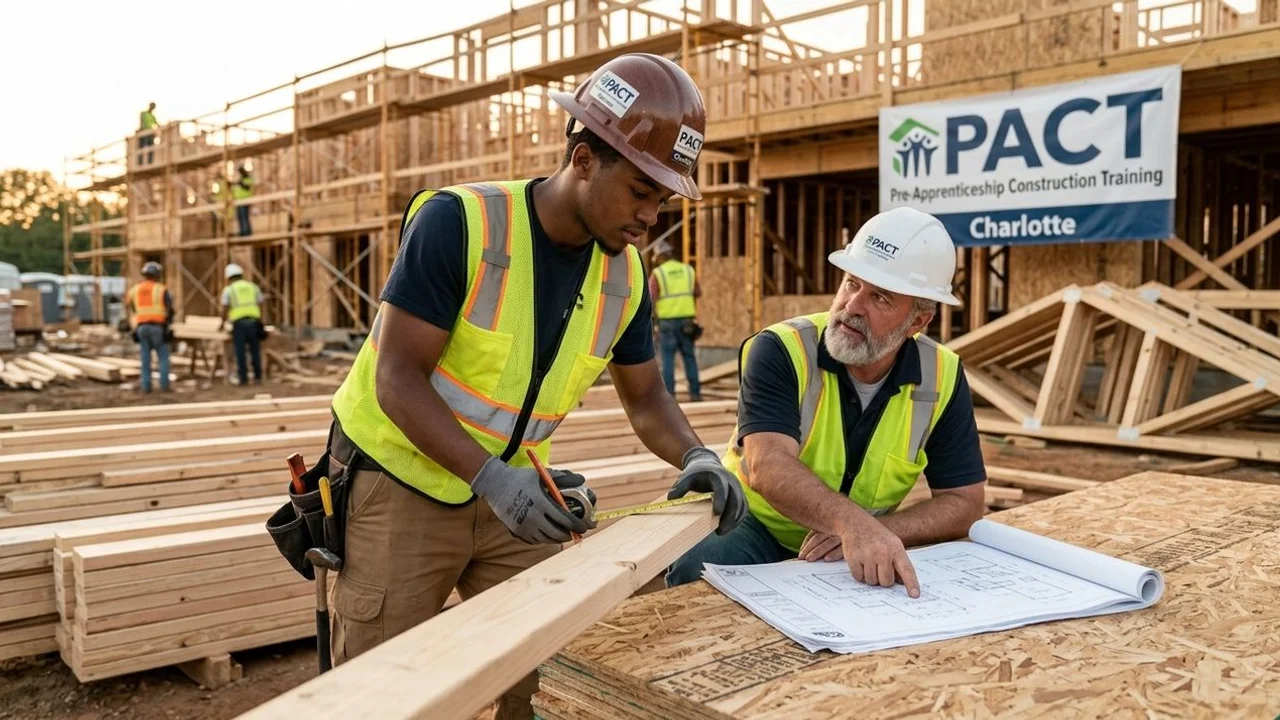
Finding reliable skilled workers is hard for Charlotte property owners and employers. Associated Builders and Contractors reported that the US construction industry needs about 349,000 net new workers in 2026 just to keep up with demand.
PACT Pre-Apprenticeship is a USDOL-recognized framework that partner providers use to prepare people for the trades. GiveNGo does not teach it. We help secure funding for launch and connect participants with providers. This guide explains what the model typically covers so you know what to look for.
Why the 25/75 split
The PACT framework pairs about 25% classroom learning with about 75% work-based training. That ratio is the spine of the curriculum. Without real hours on a site, pre-apprenticeship is just school.
| Focus area | Standard classroom-only program | PACT 25/75 model |
|---|---|---|
| Hands-on experience | Mostly theory | Majority of time on supervised work |
| Job readiness | Often needs extensive onboarding | Site habits built over time |
| Safety training | Basic overview | OSHA 10 commonly included |
What the classroom portion typically covers
Quality programs use the classroom portion to build the foundation needed to stay safe and useful on a job site. Look for a program that covers:
- Construction fundamentals. Trade vocabulary, blueprints, basic math and accurate measurement.
- OSHA 10 safety. A credential most US construction employers expect.
- First aid and CPR. Standard job-site preparedness for medical emergencies.
- Tools and materials. Hand-tool basics, fasteners, lumber and common piping such as PEX and PVC.
- Trade introductions. Carpentry, electrical, plumbing and green building basics.
- Employability skills. Resume basics, time management and workplace communication.
What the work-based portion typically looks like
The work-based portion puts participants in the field under professional supervision. This is where classroom theory turns into muscle memory. Look for a provider that offers:
- Supervised work hours. Real construction tasks under a mentor.
- Community-service builds. Affordable-housing rehabs, neighborhood repairs and public projects.
- Trade rotations. Time across several trades so participants can choose a direction.
- Documentation. Logged hours that count toward credential and apprenticeship eligibility.
A typical week
Schedules differ by provider and by youth or adult track. Youth programs often work around the Charlotte-Mecklenburg Schools calendar. A representative week might look like this:
- Monday morning. Classroom: trade fundamentals or an OSHA 10 module.
- Monday afternoon. Tool prep, safety review and travel to the job site.
- Tuesday to Thursday. Full days on a work site or community build with mentor supervision.
- Friday. Half-day classroom for life skills and employability, and half-day reflection or portfolio work.
Life skills training
Many PACT programs include Life Skills Training, a soft-skills layer that covers decision-making, conflict resolution, goal-setting and workplace communication. Technical skills matter less if a worker cannot communicate clearly with a client or supervisor. See our life skills and family support guide for more detail.
How progress is typically evaluated
Quality programs track progress through hours logged, safety observations and hands-on skill demonstrations rather than letter grades. Common measures include:
- Hours logged. Toward credential and apprenticeship eligibility.
- Safety competence. OSHA 10 completion and daily site behavior.
- Trade skill checkpoints. Per-trade rubrics such as a proper PEX crimp or safe table-saw use.
- Employability. Resume-ready, interview-ready, on time and communicating clearly.
What participants typically earn at the end
Participants who complete a PACT program typically leave with a USDOL-recognized pre-apprenticeship credential, an OSHA 10 completion card and a documented record of hands-on hours. Common next steps include a Registered Apprenticeship, an internship or an entry-level skilled-trade job. Outcomes depend on the participant, the provider and the local job market, and nothing is guaranteed.
How GiveNGo helps
GiveNGo does not run training. We connect people in Charlotte-Mecklenburg with partner training providers.
- Tell us what you are looking for.
- We match you with a partner provider that fits your schedule, eligibility and funding options.
- You move forward with support from our team.
Get matched with a provider. Requirements, costs and start dates vary by provider, and we cannot promise acceptance, funding or placement.
Common Questions
Does GiveNGo teach PACT?
How long does PACT take to complete?
Is the work paid?
Ready to find a PACT provider?
Tell us what you are looking for and we will match you with a partner provider. Requirements and costs vary by provider.