
Welder careers and pay in North Carolina: what the career ladder looks like
How welder pay in North Carolina varies by process, certification and specialty, and how GiveNGo connects you with partner welding training providers.
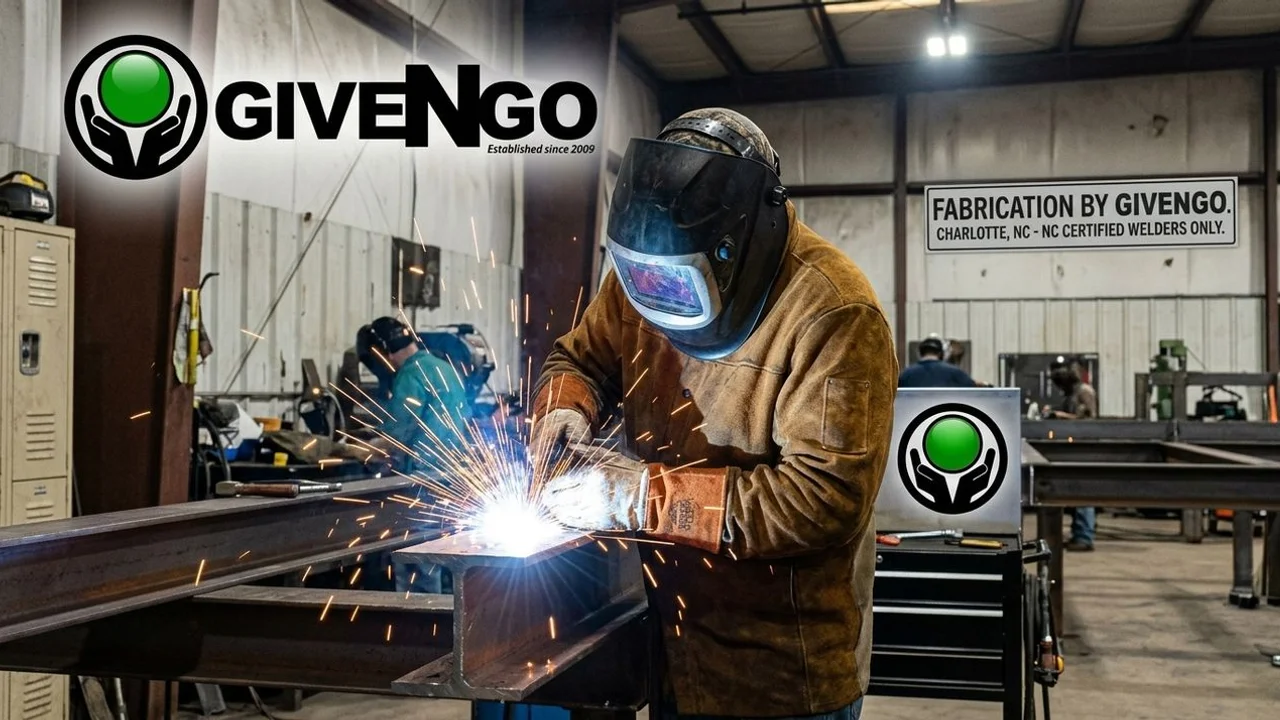
Welder pay in North Carolina tracks with process skill, certification and specialty. Manufacturing holds the largest pool of jobs in the state, while pipe welding and inspection tend to pay the highest premiums. This guide explains the career ladder so you know what to look for in a training pathway.
Pay varies by employer, certifications, location, union or non-union status, overtime and benefits. Nothing here is a promise of a specific wage.
Pay by stage
For a statewide benchmark, ZipRecruiter data from 2026 shows an average of about $56,310 a year, or about $27 an hour, for North Carolina welding professionals. Individual pay sits above or below that average depending on the stage of your career.
| Career stage | What it typically involves |
|---|---|
| Entry production welder | Basic MIG skills and on-the-job learning. Pay is usually lowest at this stage. |
| Certified production welder | Proven proficiency, often with employer-specific weld tests. |
| Structural welder (AWS D1.1) | Larger commercial and structural projects, often stick and flux-core heavy. |
| Pipe welder (combo cert) | Stick root with TIG fill and cap. Usually the highest-paying welding path. |
| Specialty or inspector (CWI) | Quality control and code compliance as a Certified Welding Inspector. |
Base pay is only part of the picture. Overtime and travel premiums for road work can raise total income significantly.
Specialty premiums
The biggest premiums usually go to pipe combo welders and AWS Certified Welding Inspectors. Mastering difficult positions and complex code requirements pushes wages up.
- Pipe welding combo (stick root + TIG fill and cap): Welders who can move between stick and TIG are in demand for industrial piping.
- AWS D1.1 structural certification: This credential opens doors to heavy commercial and bridge work.
- 6G qualified pipe welder: The 6G test proves you can weld pipe at a fixed 45-degree angle, a skill valued in energy sector work.
- Welding inspector (CWI): Moving into inspection and quality control is a different career path. Inspectors verify that welds meet safety codes.
Employer mix
Manufacturing in Charlotte and the Piedmont region employs the largest pool of welders in the state, from automotive component assembly to structural steel.
- Charlotte and Piedmont manufacturing: The largest group of jobs, often combining robotic cutting with manual welding.
- Structural fabrication: Bridge work and large commercial buildings.
- Pipe contractors: Industrial, mechanical and energy sector work.
- Maintenance and repair: Mixed work for adaptable technicians who can fix broken machinery on the job site.
What drives pay up
- Process diversity: Knowing MIG, stick and TIG is more valuable than mastering just one. It lets an employer assign you to more projects.
- AWS and employer certifications: Documentation proves your skill level. Many employers ask you to pass their own weld test during the interview.
- Position certifications (3G, 4G, 6G): Proving you can weld vertically or overhead expands the work you can take.
- Travel willingness: Road welders often earn more than shop welders, though the work means time away from home.
The PACT pathway
A structured progression helps you move out of entry-level wages and into a specialty. PACT is a USDOL-recognized pre-apprenticeship framework delivered by partner providers, and GiveNGo helped secure launch funding for it. Ask providers whether their welding training includes safety courses such as OSHA 10 and core fabrication techniques.
A typical progression looks like this:
- Complete foundational training and safety courses.
- Secure an entry welder role in a local manufacturing plant.
- Earn AWS or employer-specific certifications to validate your skills.
- Develop a specialty, such as combo pipe welding or code inspection.
Try the earnings estimator
The Trade Career Earnings Estimator can help you plan, factoring in certifications and local demand.
How GiveNGo helps
GiveNGo does not run training. We connect you with partner training providers in Charlotte-Mecklenburg.
- Tell us what you are looking for, including your goals, schedule and any eligibility questions.
- We match you with a partner provider that fits your schedule, eligibility and funding needs.
- You move forward with support as you contact the provider and get started.
Ready to begin? Get matched with a provider.
Common Questions
Pipe or structural: which pays more?
Do I need AWS certification to work?
Is welding physically demanding?
Does GiveNGo teach welding?
How do I get started?
Ready to find welding training?
GiveNGo connects you with partner welding training providers in Charlotte-Mecklenburg. Tell us what you are looking for and we will help you find a fit.